


Facial Feminization Surgery Outcomes: Real Open Data

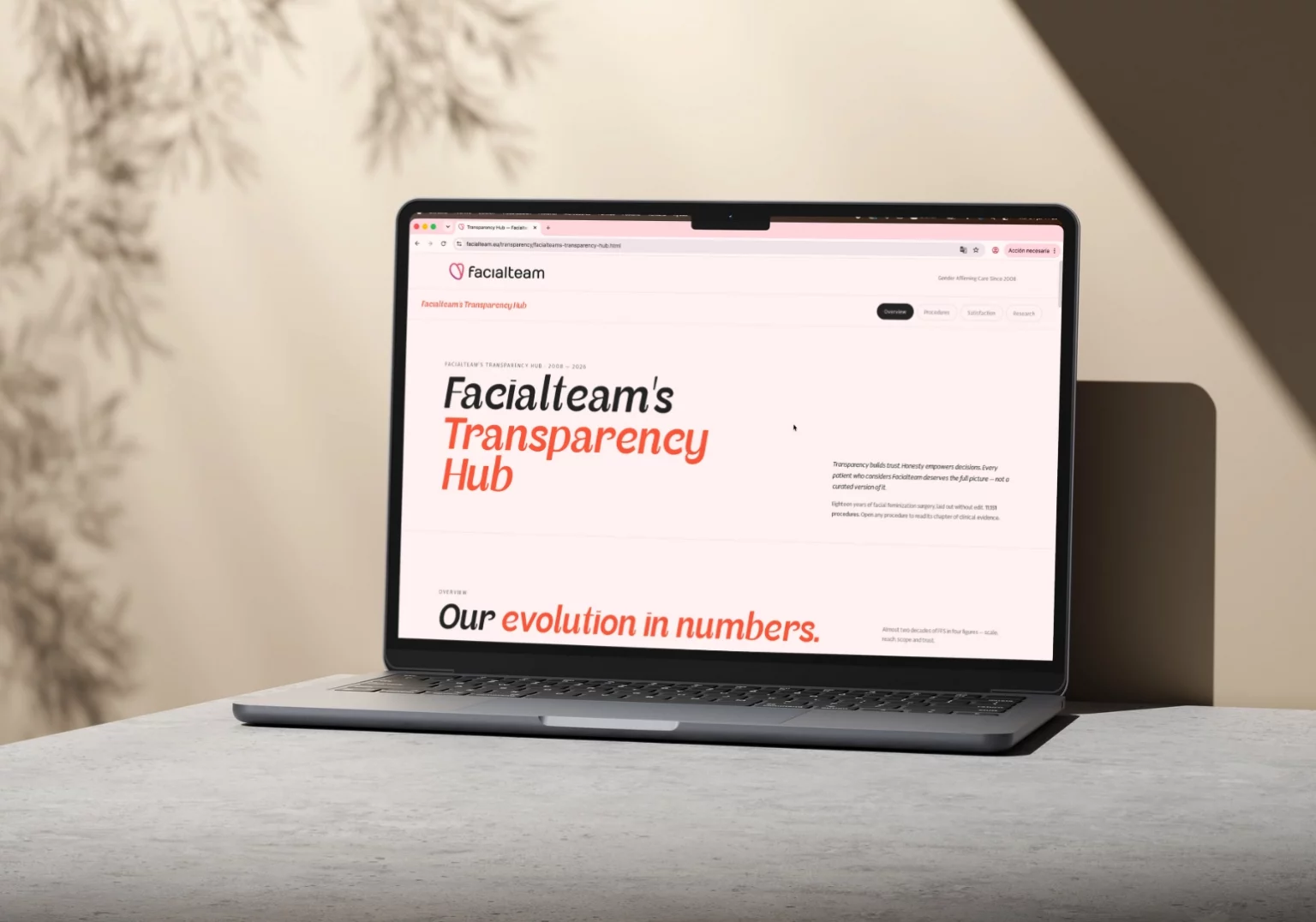
Choosing where to have Facial Feminization Surgery (FFS) is one of the most important decisions a person can make. It means placing your trust in a surgical team – often in another country – for procedures that will shape how you see yourself for the rest of your life.
At Facialteam, we believe that kind of trust should never rest on reputation alone. It should be supported by openness, evidence and accountability.
That’s why transparency has always been one of the pillars of our organisation — and why we’ve brought eighteen years of clinical, scientific and institutional data together in one place: the Facialteam Transparency Hub.

Mission of the Trust and Transparency Initiative
We know that looking for gender affirming care can feel overwhelming – clinics are often hard to read, and the medical language even harder. So we launched our Trust & Transparency Initiative: because openness and clarity are exactly what our patients, our team, and our collaborators deserve.
Behind every decision to have surgery is a simple, natural question: how do I know this team is good at what they do?
We think the fairest answer is to show our work. Since 2008, Facialteam has performed:
- 11,151 procedures across 3,582 patients
- from 64 countries
- over 18 years of practice focused exclusively on facial feminization surgery
- supported by 38 peer-reviewed publications
One year after surgery, every patient receives a follow-up questionnaire. Among those who have completed it, 98.8% rated their result as expected or better than expected.
These aren’t figures we quote once in a brochure and leave there. They live in the Hub, updated as our practice grows, so anyone — patient, family member, clinician or researcher — can see them for themselves.
Why does Transparency matter?
It’s easy to share the results that flatter you. Real transparency means publishing the ones that don’t.
Clear communication about a clinic’s purpose and the reality of surgery is vital. Here we sum up the 5 pillars of C.L.E.A.R.
1. Commitment to Communication of Care and Compliance of regulations.
2. Leveraging scientific integrity of peer-reviewed data.
3. Ethical obligations and Efficiency in care systems.
4. Affirming informed decision-making towards trust.
5. Responsibility in innovation based on Research & Relationships.
Plus, transparency matters in preventing or resolving conflicts by providing all parties with the clarity to understand issues and negotiate solutions based on shared facts.
The Transparency Hub sets out our revision and complication rates for every facial feminization procedure we offer – not as a single average that hides the detail, but broken down by intervention and tracked over time. Some are very low. Others, like rhinoplasty, are higher, because refining the nose is genuinely one of the more demanding parts of FFS. We publish all of it.
We do this because we believe patients deserve the full picture, not a curated one. Understanding how often a revision might be needed, and why, helps you ask better questions and make a more confident, more informed choice – with us, or with anyone else.

Facialteam’s Rates: What Does Transparency Measure?
Facialteam’s transparency initiative is grounded in accountability and the ethical principles of trust and respect, justice as well as important practical considerations related to quality, efficiency and innovation.
Not all efforts for transparency are measurements. We aim to inform more openly and with clarity on our institutional policies or protocols, as well as our corporate posture in areas such as Diversity-Equity-Inclusion (DEI), Human Resources (HR) and communications.
Transparency is a core component of Facialteam’s commitment to patient well-being. So the factors being measured, in the data hub for example, will range from numbers of patients and procedures, hard data about outcomes, quality perception and satisfaction with results.
The Facialteam Transparency Hub brings together information that is usually scattered across scientific journals, institutional reports and clinical records:
- Clinical activity and surgical experience, year by year
- Patient-reported satisfaction
- Quality indicators and clinical outcomes
- Revision and complication rates, per procedure
- Scientific publications and ongoing research
- Educational initiatives and training
- Institutional policies and governance
- Our commitments to ethics, diversity and continuous improvement
Don’t just take our word for it.
We publish our real numbers — procedures performed, patient satisfaction, even our revision rates. Have a look and see for yourself.

Data that drives better care
Collecting data is only worthwhile if it leads to better outcomes.
By analysing our results, monitoring patient feedback and reviewing every stage of the surgical journey, we continuously refine our techniques and clinical protocols. It’s how we identify what to improve, validate new approaches through evidence, and make decisions based on measurable outcomes rather than assumptions.
Transparency, for us, isn’t separate from quality. It’s part of how quality is achieved.
Contributing to research and education
Facial Gender Affirming Surgery is a young and fast-evolving field. As one of the world’s largest centres dedicated exclusively to it, we believe we have a responsibility not only to care for our own patients, but to help raise standards everywhere.
Publishing our research and clinical studies, sharing surgical innovations and teaching internationally is how knowledge moves forward – and the Hub reflects that, bringing our 38 publications, educational work and ongoing research together alongside our clinical data.
Accountability through openness
Transparency is also a form of accountability.
By putting our key indicators, research and institutional information in the open, we hold ourselves to a standard – and we invite patients, professionals and the wider community to see exactly how we evaluate our work. It’s a commitment that keeps us improving, and a belief we return to often: healthcare should be open, measurable and evidence-based.
Discover the evidence behind our outcomes
Transparency isn’t a marketing message. It’s part of how we practise medicine.
The Facialteam Transparency Hub lets you explore the evidence behind our work — from clinical outcomes and patient satisfaction to revision rates, scientific publications and institutional commitments.
Whether you’re just beginning to explore facial feminization surgery, or looking for objective information to support a decision you’ve already started making, we invite you to see for yourself how transparency builds confidence at every stage of the journey.
Transparency FAQ
To ensure transparency with your healthcare clinics, consider asking for such data as we’ve presented here. Also, you may like to ask these questions to gain greater transparency:
-
The Hub draws on Facialteam’s live clinical records and is refreshed as the practice grows. The current data was last updated on 29 June 2026.
-
Much of Facialteam’s clinical experience has been published in peer-reviewed journals, where independent experts scrutinise the methods and results. The 38 publications listed in the Hub let clinicians and researchers examine the underlying work — not just the summary numbers.
-
Every patient receives the same follow-up questionnaire one year after surgery, asking whether their result met expectations. Using a fixed point in time and a consistent question keeps the measure comparable year over year, rather than relying on selected reviews.
-
Revision rates vary by procedure. At Facialteam, forehead feminization (FOREContour®) has a revision rate of 0.92% and jaw feminization 0.82%, while more complex procedures such as rhinoplasty (REVONose®) sit higher at 5.55% (2020–2024). Every rate is published in full in our Transparency Hub.
-
Not necessarily. A revision refines an outcome, while a complication is an unwanted medical event – they’re tracked separately. Rhinoplasty has a higher revision rate because refining the nose is intricate work, not because it’s unsafe. Facialteam publishes both figures so the difference is clear.
-
One year after surgery, 98.8% of Facialteam patients rated their result as expected or better than expected. Of those, 39% described it as better than expected.
-
Facialteam openly publishes its full clinical record — procedures performed, per-procedure revision and complication rates, patient-reported satisfaction and 38 peer-reviewed publications — in the Facialteam Transparency Hub.
-
Since 2008, Facialteam has performed 11,151 procedures across 3,582 patients from 64 countries, making it one of the world’s largest centres dedicated exclusively to facial feminization surgery.
-
There’s no single published industry benchmark for facial feminization surgery – which is part of why Facialteam publishes its own rates openly. Making the data available helps patients compare providers more objectively, and encourages the wider field to do the same.
Authors


Related articles
10 values for gender affirming professionals
6-Step Guide to Facial Feminization Surgery

Behind the scenes with Facialteam
Best FFS Surgeons: What to Know and Where to Go

Facial Feminization Surgery Complications: The Risks of FFS.