


FFS Combinations: What are the most common?

Facial feminization surgery is a set of procedures that can be performed on their own or grouped together in one surgery, and which of those applies to you depends on your treatment plan. Some patients need one procedure. Many need a combination.
That plan is built around your own features and your own priorities, so no article can tell you what your surgery should include. What we can share is our experience. These are the most common combinations of procedures we plan at Facialteam:
- Forehead Feminization and Hairline Feminization
- Forehead reconstruction together with rhinoplasty
- Jaw angle contouring together with chin surgery
Let’s look at each one and the reasoning behind it.
Why facial feminization is planned in combinations
A single procedure can give you a feminine result. That is worth saying plainly, because combining is not about repairing something that one procedure leaves behind.
What a combination adds is harmony across the whole face. When someone looks at you, they do not study your features one by one. They take in relationships, and they do it in a fraction of a second. How your brow bone flows into your nose. How your jaw meets your neck. How the upper half of your face balances against the lower half.
So when you look at the complete picture, you often see that a neighboring area could move in the same direction, and that treating both makes the transition between them softer. Your forehead on its own can look feminine. Your forehead together with the bridge of your nose can look feminine and flow more naturally from one into the other.
There are practical reasons too. One surgery means one anesthesia, one recovery and one period away from work. But the reason we plan this way is harmony, and harmony is the whole point of what we do.

Combination 1: Forehead Feminization and Hairline Feminization
This most common combination is one we developed ourselves, and it starts with something you would assume gets thrown away.
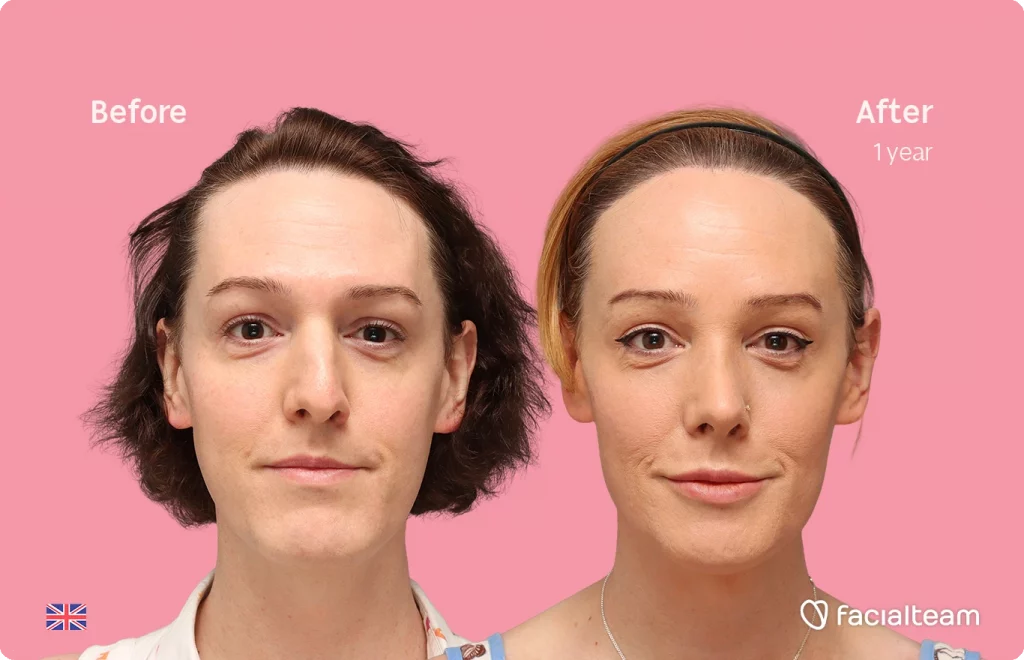
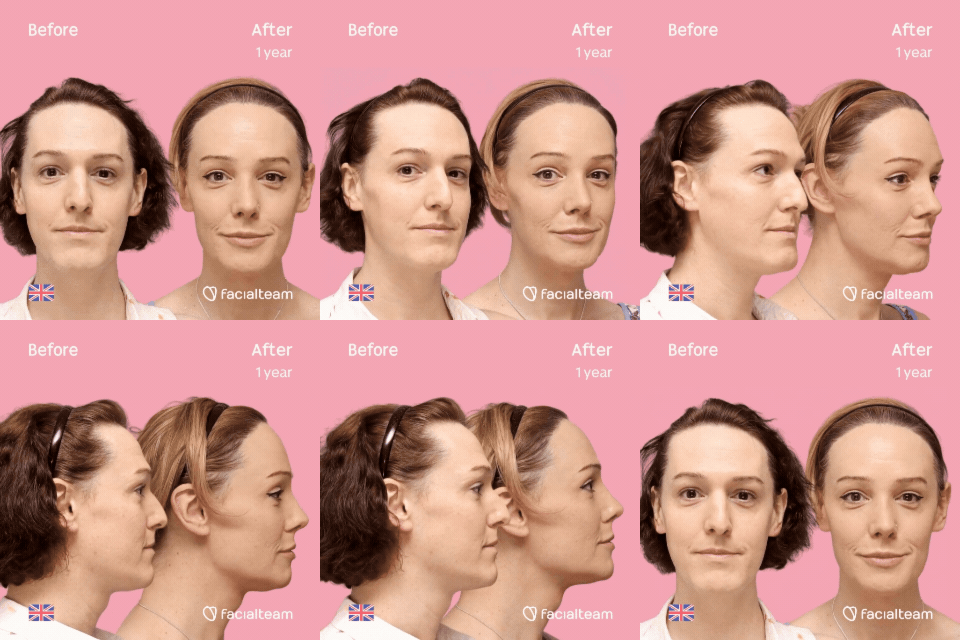
To reach the bone of your forehead we make a coronal incision, placed well behind your hairline where your hair is densest. Getting there involves removing a strip of scalp. Instead of discarding it, we can use it. The follicles in that strip are separated and then grafted along the front of your newly shaped forehead to build your hairline, all within the same surgical act. We call this a Simultaneous Hair Transplant.
The reason it belongs with forehead surgery is that your hairline is doing more work than you might think. After the forehead itself, the hairline pattern is the second strongest gender cue in the upper third of your face. Deep recessions at your temples, or an M shape at the front, will keep reading a certain way no matter how carefully the bone underneath has been reshaped. Grafting lets us round out those recessions and design a hairline that belongs to the forehead we have just built.
You can have a hair transplant before your FFS, during it, or afterward. But we recommend during, and not only because it is convenient. The donor follicles are already in our hands, you go through one operation instead of two, and you recover once.
There is one step worth explaining, because it surprises people. For the grafting stage we wake you from general anesthesia and continue under light sedation. This keeps your total time under general anesthesia down on what is already a long day in surgery. It is not painful.
An honest condition applies here. If you have androgenic alopecia, it needs to be stabilized before we can graft. And if your hair loss is significant, we can move the incision further back on your scalp so that the donor area still works in your favor.
Kezia
Combination 2: Forehead Feminization and Rhinoplasty
This is the combination we perform most often, and the one that most patients request.
Forehead surgery in Facial Feminization Surgery is about softening the ridge above your eyes, reshaping the bone around your eye sockets, and rounding the slope of your forehead. In most cases, this combines two techniques rather than one. We burr the frontal bone to smooth it, and we perform an osteotomy, which means removing the front wall of the frontal sinus, reshaping it, and repositioning it, because the bone over the sinus is too thin to be safely filed down to a feminine contour on its own. We work through an incision placed well behind your hairline, so the scar stays hidden from day one. A brow lift is added when your case calls for it.
So where does the nose come in?
Your forehead and your nose meet at what we call the frontonasal transition, the area where the bone of your brow flows into the bridge of your nose. Anatomically, they are direct neighbors, and aesthetically they behave as a single unit. Your eye does not separate them. It follows one continuous line from your hairline down to the tip of your nose.
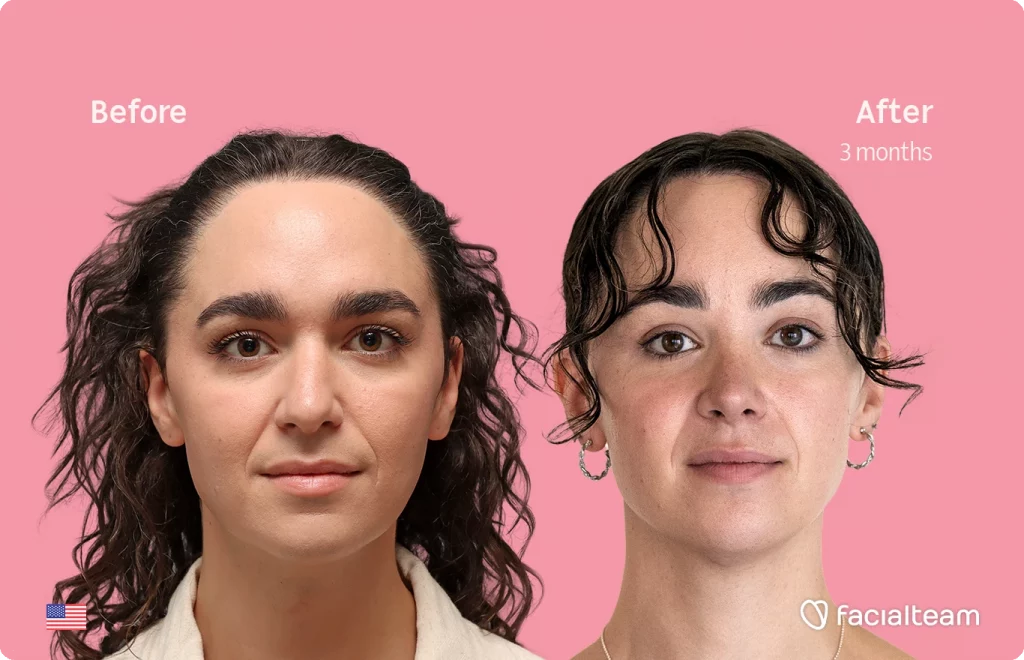
That connection is the reason we so often plan the two together. Softening your brow ridge on its own can absolutely give you a feminine forehead. Working on the bridge of your nose in the same surgery lets us shape the whole transition, so the line running from your forehead into your nose flows rather than changes direction halfway. It is a refinement rather than a correction, and it shows most clearly in profile.
Planning both at once lets us design that whole line as one shape instead of two separate results. A feminizing rhinoplasty in this context usually means narrowing the bridge, softening the profile and refining the tip, always keeping the features that make your face yours. Your heritage and your family resemblance are part of who you are, and we plan around them, never against them.
There is a comfort argument as well. Your forehead and your nose swell together and settle together. Done separately, you go through that same swelling twice for the same part of your face.

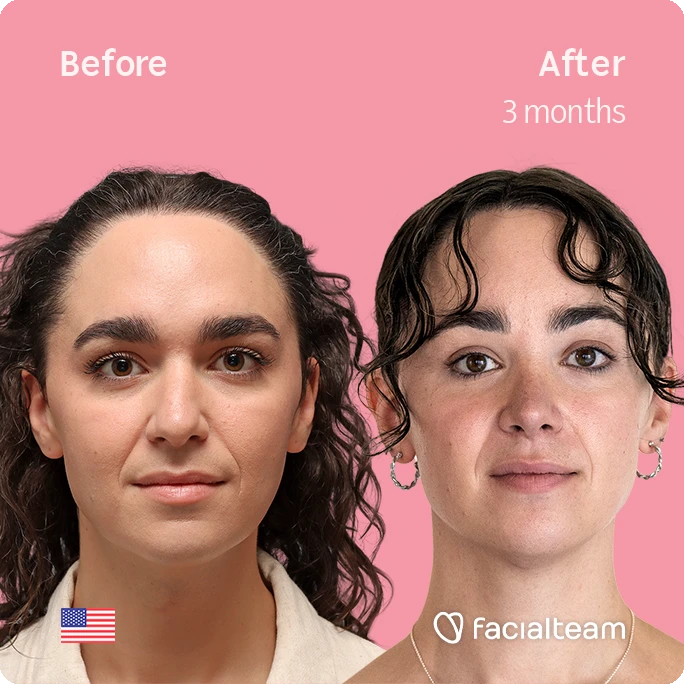
Elle D.

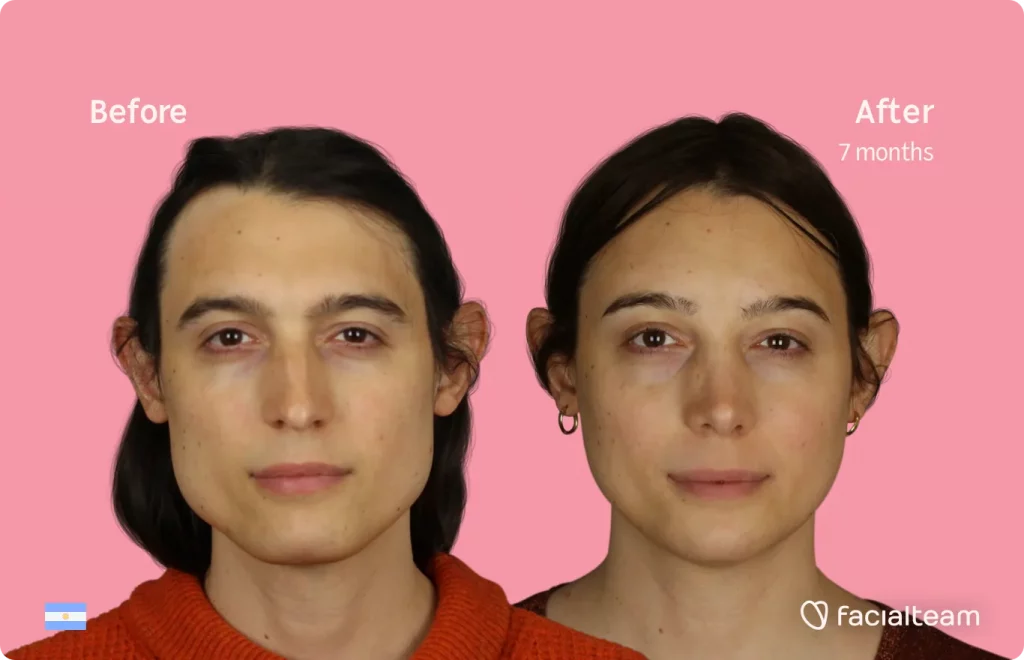
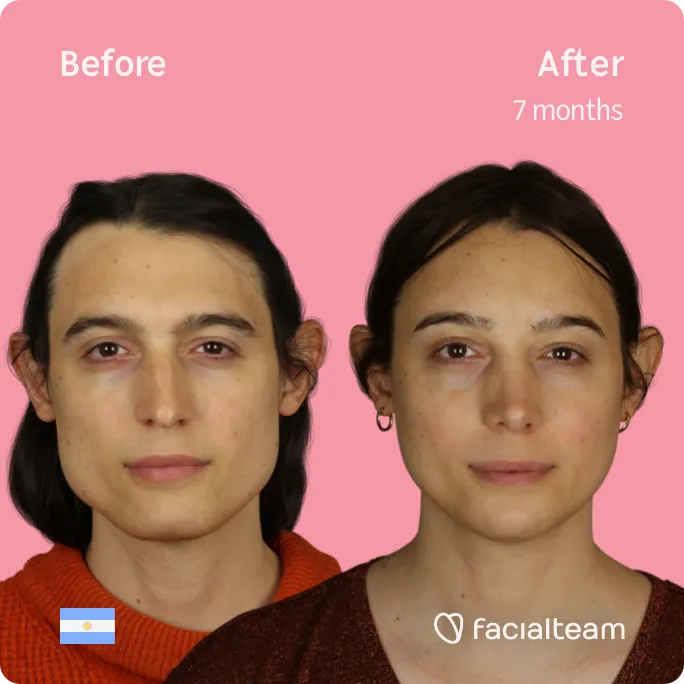
Combination 3: Jaw angle contouring and chin surgery
This third pairing comes up less often than the forehead with the nose; plenty of plans include only the chin, or only the jaw. What we do find is that when the lower third of your face is what you want to change, working across the whole of it gives a more coherent result than treating one part of it on its own.
A more masculine lower face usually carries several traits at the same time. The chin tends to be taller, wider at its base, squarer in shape and further forward. The angles of the jaw tend to be wider and more flared, with a broader stretch of bone running between the angle and the chin.
Your jawline is one continuous curve, and that is what explains this pairing. Reshaping your chin on its own already softens the lower part of your face. Reshaping your chin and the angles of your jaw in the same surgery lets us carry that softer line all the way around, from the angle of your jaw to the center of your face, with nothing interrupting it along the way. Seen from the front, it is that continuity that narrows your lower face rather than only its tip.
The lower face takes its time, and it helps to know that from the start. Swelling settles more slowly here than on your forehead, so a soft diet will be part of your first weeks. Some numbness along your lower lip and chin is a normal stage of how this area heals, and it resolves for the large majority of patients. The shape keeps refining for months afterward, which means what you see at week three is not your final result.
Simone
How these combinations build a full FFS plan
Most of our patients do not stop at one pairing. A very common single surgery includes the upper third and the lower third together, so forehead reconstruction with hairline advancement, rhinoplasty, jaw and chin contouring, and a tracheal shave, all in one operation.
Staging still makes sense in some cases. Longer procedures need a patient in good general health. Budget and available time off work are legitimate factors.
How do you know which combination is right for you
Two things guide the plan. The first is the analysis, which in our case is built on 3D imaging and virtual surgical planning on your actual skull, so you can see the proposed changes on your own anatomy rather than on a generic model. The second is you.
There is often a gap between the feature a patient thinks about every day and the feature an observer actually registers first. Part of the consultation is closing that gap honestly, in both directions. Some patients arrive fixated on their nose when their brow is doing most of the work. Others are ready to accept a jaw that still bothers them because the chin is what they see in the mirror. Both positions are valid, and the plan should follow the patient’s priorities once the information is clear.
A Successful FFS Experience Starts with a Conversation
Your journey toward Facial Gender Affirming Surgery is unique, and it all begins with an open, caring conversation. Talk to our specialists today to discuss your goals, ask questions, and create a personalized plan that helps you feel truly yourself every step of the way.
Frequently Asked Questions
-
In most cases, yes. A full plan combining forehead, nose, jaw, chin, and tracheal shave runs to roughly nine or ten hours of surgery, and we do this routinely for patients who are medically fit for it.
Twelve hours is our limit, and that is what a full facial surgery looks like when something else is added to it, a breast augmentation for example. At the other end of the scale, the shortest standard surgery we perform is a tracheal shave on its own, at around an hour and a half.
-
It does mean more time under anesthesia, and we assess that individually during your preoperative tests. It is also the reason for the twelve-hour ceiling, which exists to protect you rather than to limit what you can have. Within that, you go through one anesthesia instead of several, and one recovery instead of several.
-
Generally yes, because operating room time, anesthesia, and your hospital stay are shared across the procedures instead of repeating for each one.
-
Most patients feel comfortable being seen in public at around two to three weeks. Swelling keeps going down over the following months, and the bone results in the lower face are the last to show their final shape. Patience is genuinely part of the process.
-
No. Our surgeons recommend the treatment plan they consider best for your individual case, and part of that conversation is explaining how closely your forehead and your nose are connected, and how softening your brow can change the way your nose is perceived in profile. The final decision is always yours. Some patients prefer to see how they feel with the forehead alone and come back to the nose later.